The Living Lab Wheel
The Living Lab Wheel is designed to guide you through the process of setting up and running a living lab. It provides step‑by‑step support, along with methods, tools, and resources for each stage of the process. This will empower your teams by unlocking the potential for socio-ecological transformation.
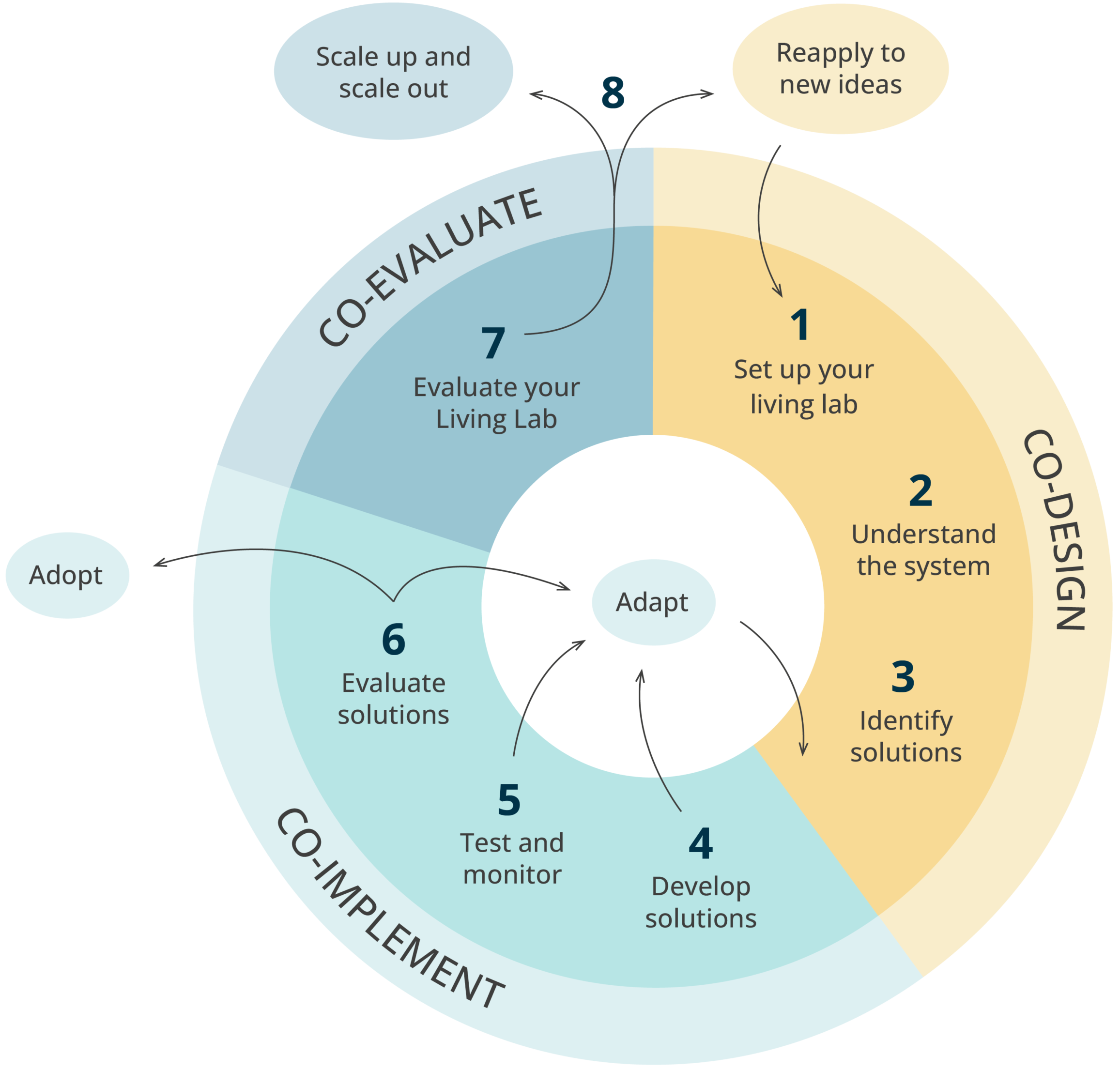
Step 1: Set-up your Living Lab
By the end of this step, you will have a well defined framework that guides the different phases of your living lab.
Read More →Step 2: Understand the system
By the end of this step, you will understand the key drivers and root causes of socio-ecological challenges, laying the…
Read More →Step 3: Identify solutions
By the end of this step, you will have explored and prioritised the solutions to be co-developed, tested, and refined…
Read More →Step 4: Develop solutions
By the end of this step, you will have identified the potential impacts of your solution and assembled a dedicated…
Read More →Step 5: Test and monitor
By the end of this step, you will have practical insights into how each solution works in a real-world context…
Read More →Step 6: Evaluate solutions
By the end of this step, you will decide whether each solution should be adapted by returning to Step 3…
Read More →Step 7: Evaluate the living lab process
By the end of this step, you will understand how effectively the collaboration addressed challenges and empowered communities for socio-ecological…
Read More →Step 8: Upscaling and wrap-up
By the end of this step, you will have a pathway for scaling or transferring your solutions and learnings to…
Read More →Co-design phase
A shared purpose, a clear understanding of challenges, and the right people are critical for driving ambitious transformations through collaboration.…
Read More →Co-implement phase
To work, solutions must be grounded in the local context and informed by diverse perspectives. Through three steps, solutions are…
Read More →Co-evaluate phase
You have learned so much implementing your living lab, which may have produced outcomes of relevance far beyond your region.…
Read More →Co-design phase
Steps 1-3
Teams are guided to set up a living lab, to understand socio-ecological challenges, and actively involve diverse actors in defining them, exploring them, and co-designing solutions.
Co-implement phase
Steps 4-6
Ideas are translated into action. Teams prepare and develop the proposed solutions for testing, monitor and evaluate their impacts, and adapt or adopt evaluated solutions.
Co-evaluate phase
Steps 7-8
Teams co-evaluate their living lab process and the outcomes achieved. They do this in relation to their co-designed ambitions, and the potential socio-ecological transformation goals.
What are Transformative Living Labs?
Collaborative environments that enable communities to drive socio-ecological transformations by sharing ideas, knowledge, and solutions, leveraging real-world experiments, continuous learning, reflection, and adaptation.
Key characteristics
Empowers People to Collaborate
Co-creation with different actors and citizens is key. Complex, often conflicting, environmental and societal challenges can be addressed.
Supports Transdisciplinary Approaches
Co-creative and stepwise participatory processes are leveraged that promote mutual learning and reflection among partners, including citizens, business, decision makers, and scientists among others.
Evidenced by Experimentation
Solutions are developed and refined through iterative testing, evaluation, and continuous learning and adaptation to ensure that sustainability challenges are truly addressed.
Enables Transformative Change
Global challenges, such as climate change, biodiversity loss, and social inequalities, can be addressed. Systemic shifts are driven by scalable solutions grounded in local contexts, to ensure relevance and achieve long-term sustainability goals.


Why use this Living Lab Wheel?
Living labs are often initiated by project teams, researchers, public authorities, businesses, or community groups working to address complex socio‑ecological challenges. This tool is designed for anyone involved in such processes, whether you are starting a living lab yourself or contributing to an existing one.
Demystifying the mystical
Living labs are increasingly being established as open and dynamic, yet structured, collaborative processes aimed at addressing sustainability challenges. A range of frameworks, tools, and guidelines already exist to support these processes.
The Living Lab Wheel builds on this existing knowledge by bringing it together into a clear, step‑by‑step structure tailored to socio‑ecological challenges. It combines guidance, methods, and practical tools in one place to support teams in navigating the process from start to finish.
The Wheel is not a fixed recipe, nor does it replace local knowledge or expertise. Instead, it provides a flexible framework that you can adapt to your context, helping you make informed decisions rather than prescribing exactly what to do.